Showing posts with label ai. Show all posts
Showing posts with label ai. Show all posts
Wednesday, April 5, 2017
How driverless cars will transform auto insurance and shift burden onto AI and software
How driverless cars will transform auto insurance and shift burden onto AI and software
In the era of autonomous cars, driving will become safer. With a predicted 80% drop in accidents by 2040, there are major implications for the car insurance industry. Heres what you need to know.

With almost every major car company—and even tech companies like Google and Apple—looking to unveil models of self-driving cars in the next few years, considerations for car safety are being radically altered. According to a report from KPMG, there will be an 80% drop in accident frequency by 2040.
So what does this huge drop in accidents mean? According to Jerry Albright at KPMG, "the implications for the insurance sector are going to be profound. They have to completely transform their business model."
How cars are getting safer
Humans are responsible for 90% of the accidents on the road, said Albright. So when cars make more and more decisions, with tools like like lane assist, self parallel parking, traffic jam assistant and more, accidents drop. "When you remove the human element with something that can react quicker, detect with sensors and lenses, perform a full environmental driving scan," said Albright, "the vehicle risk profile is going to change, and its going to get safer."
SEE: Autonomous driving levels 0 to 5: Understanding the differences
And, as automated vehicle technology moves toward level 5—offering a completely driverless experience—safety increases. The Insurance Institute for Highway Safetys research shows that fully-engaged technology, meaning that you dont turn off any function, translates into a 7% to 15% reduction in property damage claims. Still, "you dont have to wait to be at a level four to realize the safety benefits," said Albright. "Each generation, each capability that advances the autonomous technology—be it lane assist, stop and go traffic—all of those continue to improve the safety profile of the car."
The rise of the "smart" car
Another way that safety is increasing is through car to car communication. Cars "talk" to each other. "Were anticipating a smart environment in which cars will be talking to the stoplights, to the guardrails, actually to the pavement itself as well as to the other vehicles," said Albright. Its like "a spider web of interactive interchange of communication—as it gets denser and denser, the safety factor continues to advance."
In many ways, autonomous cars can become safer by continuing to learn about the driver. "Its going to also learn from the cumulative driving of all the other drivers," said Albright. Vehicle-to-vehicle communication, (V2V), means that cars will start interacting with other cars. And, eventually, they will also "talk" to the infrastructure at some point, or vehicle-to-infrastructure (V2I).
"Youre essentially accumulating driving information from all of their vehicles on the road," said Albright. "If youre driving down 290 West in Chicago and see a huge pothole in the left-hand lane and all the cars are swerving around it, your car then tells all your other cars that are going on 290 West to watch out."
Impact on insurance companies
Insurers have typically considered the past to be an indicator of whats going to happen in the future. But whats happened over the last 100 years is radically different than what the next five to ten years will bring. "You go from human behind the wheel to no human behind the wheel," said Albright "How do you accurately predict what you should be charging people from a premium perspective on their insurance when the world is totally different than its been for the last century?"
The key, he said, is to be proactive. Its no longer an option to deny that self-driving cars will be a reality. "The thing thats plaguing a lot of insurers," said Albright, "is disbelief that this is ever going to happen, or its going to happen too far in the future to do anything about it now. They are weighed down by legacy systems and process and all sorts of other things that do not enable them to act nimbly to massive changes in their environment," said Albright.
Now is the time for a "call to action," he said. "They need to completely reevaluate their business strategy."
So its time for businesses to answer some core questions, said Albright, like how to sell business, who to sell to, how to underwrite risk, and how to manage claims."Every core component of doing insurance right now will change," he said.
With new technology comes new risks
Of course, automated driving does not mean that accidents will be altogether eliminated. There will still be bad weather, animals darting in front of vehicles, and other unforeseen circumstances that will lead to crashes. Also, there are still problems with the technology behind level 3 driving, in which drivers are handed back control from the system.
Gill Pratt, head of the Toyota Research Institute, which is studying AI, said that this hand-off can sometimes be dangerous. "Our view is that in certain circumstances, hand-off can be valuable, but in others, it cant," he said. "The important thing is to make sure that drivers know what to expect and arent surprised when a car hands off control back to the driver."
But the big change in insurance is likely to come from a shift in focus, going from covering the car itself to the software of the car. "That may well become the majority of the driving exposure and the component of the insurance," said Albright. "Thats a different product from the personal auto insurance that you or I would buy for our car."
Thilo Koslowski, an analyst at Gartner, believes that we will always have a need for insurance. "Technology can fail. But we will move from a driver-centric approach to a product-centric approach. Going forward, manufacturers would insure that the vehicles will function, rather than putting the burden on the driver."
Instead, car insurance companies will need to broaden the scope of what constitutes potential safety threats. Cybersecurity, for example, is one of the biggest areas of concern.
According to Koslowski, "the companies have to master cybersecurity. They have to consider it wholistically—data communication, the cloud, and a cybersecurity approach needs to be on the table."
"I hope the industry is taking it seriously enough," said Koslowski.
The 3 big takeaways for TechRepublic readers
1. The auto insurance industry will change dramatically with autonomous vehicles, and the burden of indemnity could switch from drivers to the software and systems powering the vehicles.
2. The driverless cars of the future will talk to each other (V2V) and the infrastructure around them (V2I) to provide a far safer driving experience than humans currently can.
3. With the rise of autonomous vehicles, there are will be demand for a lot more tech jobs in the auto industry in the years ahead.
Go to link Download

Thursday, October 6, 2016
Google Embeds AI in New Products to Make Search Ubiquitous
Google Embeds AI in New Products to Make Search Ubiquitous
New digital personal assistant part of broader AI strategy
Assistant to appear in Allo messaging app, then Home device
Google is turning to artificial intelligence to make sure people keep using its search engine, even if they’re not spending as much time on the Web and personal computers
Google became one of the world’s most valuable companies by making a search engine that sucks in billions of queries people type into web browsers on PCs and phones. Google sells ads based those indications of intent and desire. But that search advertising money machine is at risk as computing evolves and gives people new ways to find what they want -- and new avenues for competing companies to satisfy those wants.
The new products unveiled Wednesday -- and future ones using the same Google AI technology -- give the company a chance to keep its search engine relevant in an era of new, connected devices.
Conversational interface
With the future of search -- and intent-based advertising -- up for grabs again, AI has become a big strategic area of investment for many technology companies. The bet is that whoever makes the most engaging and useful digital personal assistant, also known as the conversational interface, will control the layer between a person and their digital life, and collect the most revenue and profit from being that privileged broker.
Google has been working on artificial intelligence -- technology that lets computers teach themselves about the world -- for more than 15 years. The company hopes this expertise can help it build conversational computing products that beat the competition.
"It’s absolutely strategic," said Scott Huffman, a vice president of engineering for search. "If you think about this simple idea of having a conversation, that is the interface that all the people around you have."
Google hopes that if it makes it easier for people to access its services, they’ll use them more. That’s a pattern it has seen with other technology initiatives. "Every time we’ve had an improvement in voice recognition we see a corresponding jump in usage," Huffman said.
Conversational computing is a crowded field. Amazon’s Echo, which has been a bestseller for the company, lets people use their voice rather than type to search for things and order them from Amazon’s online store and play music through Amazon-owned services, cutting out Google. Microsoft Corp.’s Cortana AI assistant embedded in Windows 10 lets people ask questions that the company answers via its Bing search engine. Facebook Inc.’s digital assistant, M, uses some AI to let people get answers to questions and perform actions such as ordering flowers, and its recently unveiled chatbot platform gives companies a way to chat directly with consumers, no Googling required.
Allo Google
Over time, Google said it will develop other products and services using the same digital assistant, which will stay with people across devices, and remember their habits, Huffman said. That will let Google’s search and other services follow people from smartphones and smart watches into their car and homes. Google plans to add more AI capabilities to its assistant, some of which won’t necessarily appear in its main search engine, Huffman said.
The company’s Allo messaging app will come out this summer. It will suggest responses to messages by reading and understanding people’s text conversations. A contact named "@google" can be summoned by users to provide AI-powered services, like finding restaurants and booking tables, or searching for movies.
The AI in Allo is based on technology already deployed in Google’s Inbox program, which reads through e-mails and suggests appropriate replies. It also understands images sent in text messages, using its AI to look at what is in the picture and suggest its own comments.
The more people use Allo the better the AI will get. The system works by converting words and images into sequences of numbers explicable to Google’s machine intelligence, letting it develop intuition so it can guess the word "dog" is semantically similar to puppy, or that the appropriate response to a picture of someone skydiving is "brave."
In a recent demo, Erik Kay, a Google director of engineering for communications products, took a photo of colleague Amit Fulay, who posed with an exaggerated grin. Kay texted the photo to Amit using Allo, and on Amit’s phone the AI studied the photo, noticed the grin and came up with the response "sunny smile :-)". These kinds of automated responses are meant to give people a more satisfying conversation, but has the additional benefit of generating more data for Google to use to further develop its AI.
Google Home
After Allo, the company plans to release the Google Home device that people can speak to. The gadget will play music, communicate with other Google devices, and answer questions using Google’s AI assistant and its search engine, along with managing other Google products like Calendar and Gmail. People will summon it by using the same call out -- "OK, Google" -- that is used in other existing Google mobile apps. "Hey, Google" will also work.
"We don’t necessarily have to be first every time, that’s not actually our goal, but we want to be the most scalable solution," said Rishi Chandra, a vice president of product management for Google, noting the product is "not an assistant that does three things but it can really do anything."
Over time, Google said its AI will gain new capabilities. The company plans to give it a more flexible memory, so when people have a conversation where a friend references their home address, it will learn to associate that location with them. A technology called “Expander” will help the technology work in multiple languages, with insights gleaned from AI deployed in one language feeding the intelligence of the software in another tongue.
But it will take time for the AI to be able to anticipate and respond to every request, said Huffman. "It’s nice job security for us because it’s going to take it a while to let it do anything people want to do."
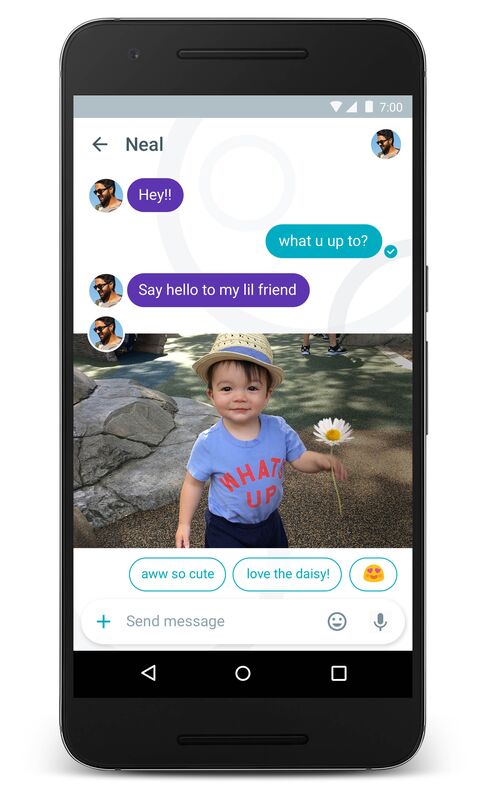
Google Allo can study the photo and suggests possible responses.
The Alphabet Inc. division unveiled a new mobile messaging application Wednesday called Allo containing a digital personal assistant, based on AI technology that powers other Google services like Inbox.
At its I/O developer conference near its Silicon Valley headquarters, the company also showed off a voice-based search device called Google Home that uses the same assistant technology to answer questions when people are in their houses, a potentially potent rival to Amazon.com Inc.’s popular Echo gadget.
Google Chief Executive Officer Sundar Pichai said the goal is to develop an “on-going two-way dialog with Google” and build billions of people their own “individual Google.” The CEO sees the Google digital assistant as an “ambient experience that extends across devices.”
Go to link Download
Subscribe to:
Posts (Atom)